Why is my electric bill so high? Five things to check.
A bill that jumps usually has a reason you can find on the bill itself or on your plan's Electricity Facts Label. Here are the common ones in the parts of Texas where you choose your electricity provider, in the order that's quickest to check.
1. You used more electricity
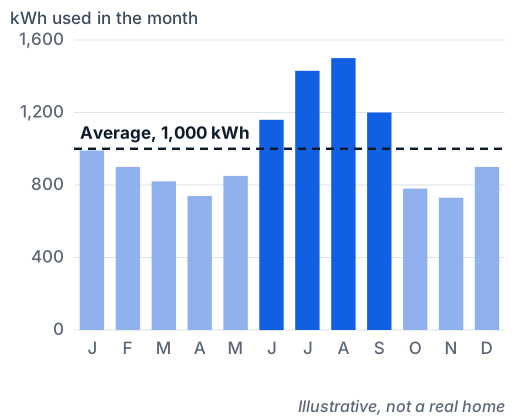
Find the line on your bill that shows how many kilowatt-hours (kWh) you used, and compare it with the same month last year, not last month. In Texas, air conditioning makes summer use far higher than spring or fall, and electric heat can do the same in a cold snap. If the kWh went up, most of the bill went up with it.
2. The bill covers more days
A bill runs from one meter reading to the next, and that period isn't always the same length. A few extra days means a few extra days of use. Check the service dates printed on the bill.
3. Your contract ended
A fixed-rate plan runs for the term on its Electricity Facts Label. When the term ends, you pay whatever your provider charges then, unless you pick a new plan. That price can be well above the one you signed up for. Your provider is required to send a notice before the term ends; if your bill went up and you can't remember when you last chose a plan, this is the first thing to look for.
4. You missed a credit, or paid a minimum usage fee
Some plans take a credit off your bill only in a month you use at least a set amount. Miss the line, even by a little, and you get none of it, so a mild month can cost more than you'd expect. Other plans add a fee in a month you use less than a set amount. Both are on the label, and both are explained in our guides to bill credits and minimum usage fees and usage tiers.
5. Delivery charges changed
Where you choose your provider, part of every bill pays the local utility to deliver the power. In the areas we cover, that's Oncor, CenterPoint, AEP Texas, TNMP or Lubbock Power & Light. Those charges are set in the utility's own tariff, not by your provider, and they're the same on every plan in your area. They can change more than once a year, and a plan that passes them through changes with them.
How to check your own bill
- Compare this bill's kWh with the same month last year. Your provider's website or Smart Meter Texas shows your usage history.
- Check the service dates, and count the days.
- Find your contract's end date on your provider's account page, your welcome documents or a contract expiration notice.
- Open your plan's Electricity Facts Label and look for a credit, a minimum usage fee, or a rate that changes past a usage line. Our guide to reading an Electricity Facts Label shows where each one is.
If it's time for a new plan
The plan with the smallest price at one usage level isn't always the one that costs the least over your year. A watt marshal report shows which plans would have cost the least on your usage, within each contract length.
More guides
Bill credits
How a usage bill credit works, why a month just under the line costs the whole credit, and how your report counts it.
Minimum usage fees and usage tiers
A fee for using too little, a rate that changes past a line, and how each one lands on a real year of bills.
Reading an Electricity Facts Label
Where to find a plan's label, what each section says, and the lines that decide what you pay.
Want your own plans read this way? Start with your ZIP.
We rank every fixed-rate plan we can price in your delivery area on your twelve months of usage, within each contract length.